
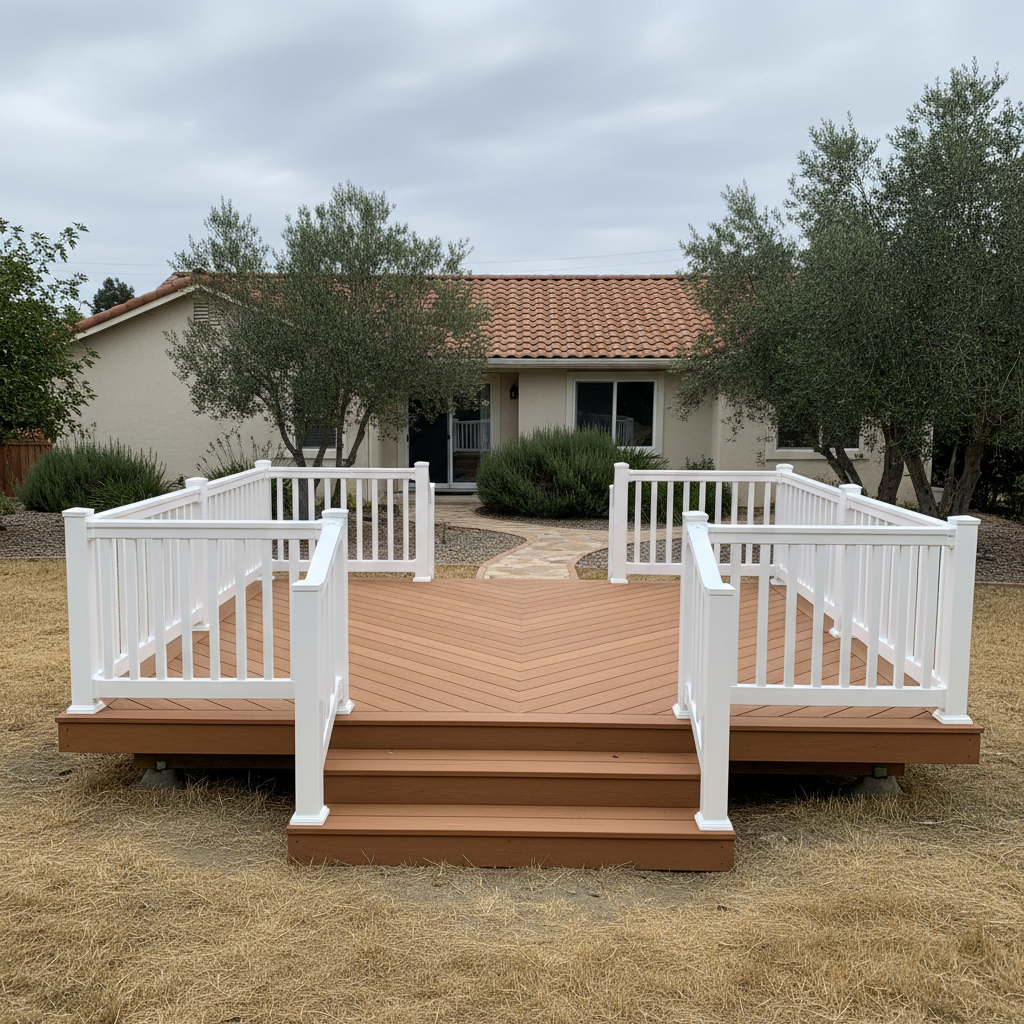
Glendale has more decks going up than it used to, especially in the hillside neighborhoods where a flat backyard is rare and a deck off the back of the house is the only real outdoor space available. That also means more people are calling themselves deck builders than ever before, and the gap between a good one and a bad one usually doesn't show up until year two or three, when a railing starts to wobble or the ledger board starts pulling away from the house.
Start with the license, not the price
In California, deck framing falls under a contractor's license, usually a B (general building) or C-5 (framing and rough carpentry) classification through the CSLB. Ask for the license number before you sign anything and look it up yourself on the CSLB site. It takes two minutes and tells you whether the license is active, whether there's a bond behind it, and whether there's a complaint history attached to it. A contractor who hesitates when you ask for the number is telling you something. One who hands it over before you even ask is telling you something too.
Ask about workers' comp coverage as well, not just general liability. If someone gets hurt on a ladder at your house and there's no comp policy behind the crew, that liability can land on you.
Who pulls the permit, and why that matters here
Most decks over 30 inches off grade need a permit through the City of Glendale's Building and Safety division, and given how many lots in this city slope, that covers a lot of decks. The inspector checks footing size and depth, how the ledger board ties into the house, joist spacing, and railing details like the 4-inch maximum gap between balusters. If a builder tells you a permit is optional or that it's better to keep the job quiet, that's a reason to find someone else. Unpermitted work surfaces at resale. A buyer's inspector in Rossmoyne or Chevy Chase Canyon knows what a permit record looks like, and knows what it means when one doesn't exist.
Parcels near the Verdugo Mountains and the La Crescenta border can also fall inside a hillside or fire hazard overlay, which sometimes means extra review on the footing design or the materials allowed. A builder who's worked those streets before won't need you to explain that to them.
What the timeline actually looks like
A straightforward deck permit in Glendale usually runs a few weeks through plan check, longer if the deck needs engineering because of height, span, or hillside footings. Once the footings are poured, the concrete needs a few days of cure before framing can load onto it, even though full strength takes closer to 28 days. If new pressure-treated lumber is going to be stained, it needs 4 to 6 weeks to dry out first, or the stain won't absorb evenly and you'll see blotching within a year. A builder who promises to stain brand-new treated lumber the week it's installed either doesn't know this or is hoping you don't.
What's actually holding the deck up
Ask what the footings will be. On fill soil or clay, which shows up around the flats near the LA River and in some of the older parts of the city, an undersized footing settles unevenly over a couple of winters and you feel it as a soft spot or a slight lean. A standard footing runs around 12 inches square by 18 inches deep, more for a tall multi-level deck or one carrying a hot tub, and it should sit on undisturbed soil, not loose backfill.
Ask what fasteners go into the ledger board, because that connection is the single most common failure point on a residential deck. It should be lag screws or structural screws rated for the load, with flashing tucked behind it to keep water out of the joint between the ledger and the house's rim joist. Ask if the joist hangers are hot-dip galvanized or stainless. Standard electroplated hardware corrodes fast against the copper-based preservative in modern treated lumber. A builder who shrugs at that question probably isn't thinking about what your deck looks like in year eight.
Material matters more than the sample board
Redwood and cedar hold up fine in Glendale's dry summer heat, but they need staining or sealing every two to three years or the sun bleaches them out, especially on a west-facing deck taking full sun through July and August. Composite decking costs more up front but skips most of that maintenance, which matters if you don't want to be on a ladder every other summer. Ask which product line is actually being quoted, not just "composite," since warranty length and color stability vary a lot between a builder-grade board and a better one. If the lot sits inside a fire hazard zone near the foothills, ask whether the decking and under-structure have to meet an ignition-resistant standard. Some hillside parcels do require it, and it narrows which boards are even an option.
Red flags that should end the conversation
- A quote well below two or three others for the same scope. Someone is cutting footing depth, fastener grade, or insurance to hit that number.
- No written contract, or one that doesn't spell out board brand, fastener type, footing spec, and a payment schedule tied to progress.
- Pressure to pay the full amount up front. A deposit is normal. Paying it all before a footing is even dug is not.
- No mention of a permit, one way or the other.
- Vague answers about ledger attachment or hardware grade when you ask directly. This is the detail that separates someone who builds decks for a living from someone who's done a few.
A deck in this city has to deal with five months of dry heat, the occasional heavy winter downpour that turns a sloped yard into a runoff path, and in a lot of neighborhoods, soil that isn't flat or simple. None of that is unusual for a builder who's worked here before. We handle the permit conversation, the footing design on sloped lots, and the material choice for sun exposure as part of our deck builder work around Glendale, and we'd rather spend twenty minutes answering these questions on site than have a homeowner find out the hard way in year three.